
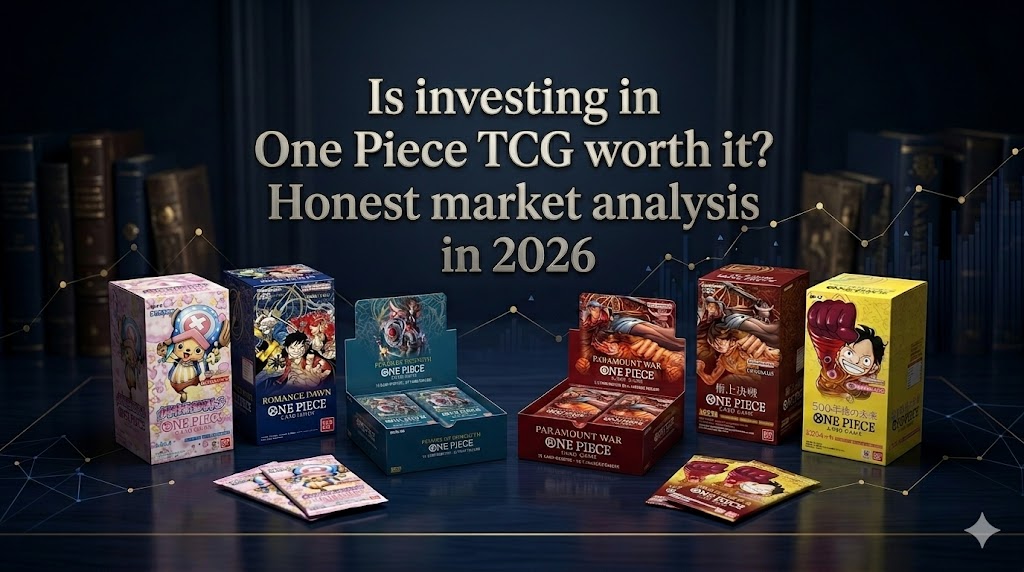
Is One Piece TCG Worth Investing In? An Honest 2026 Market Analysis
Is One Piece TCG a gold mine or a bubble? We analyze the European market data, Bandai's reprint policy, and the real ROI of sealed products in 2026.
Last updated:
Every few months, a new wave of articles claims that investing in One Piece TCG is the next great collecting bubble. The reality, as we move through 2026, is significantly more nuanced. This honest analysis reviews real European market data, concrete appreciation cases, the risks most writers omit, and the strategies that genuinely make sense for different buyer profiles in the current UK and EU landscape.
You won't find guaranteed-return promises here, nor "buy this, you can't lose" tips. Instead, we provide the evidence-based arguments to help you decide if dedicating capital to this market fits your risk appetite. A reasonable spoiler: for some profiles, the answer is a resounding yes; for others, it is a clear no.
What "investing" in One Piece TCG actually means
Before looking at spreadsheets, we must define what we are doing. In the TCG (Trading Card Game) world, there are three distinct profiles: the competitive player (buys for utility), the emotional collector (buys for the art/character), and the buyer expecting appreciation. We define an investment as the intentional acquisition of assets—sealed or singles—with the primary goal of selling them later for a profit.
Sealed product vs singles
Sealed product (booster boxes, premium collections) is generally considered the "low-risk" entry point. It offers better liquidity and acts as a lottery ticket for future collectors. Singles, specifically Manga Rares or high-end Alt Arts, offer higher potential upside but are more susceptible to local damage and market volatility if the meta changes.
Time horizons: short, medium and long term
- Short term (3–6 months): Highly speculative. Relies on "flipping" pre-orders or riding the hype of a new meta-relevant deck.
- Medium term (1–3 years): The sweet spot for most. This spans the period between a set being "in print" and becoming "out of print" (OOP).
- Long term (5+ years): Reserved for blue-chip assets like OP-01 boosters or the rarest commemorative promos.
The European One Piece TCG market in figures
Unlike the US market, Europe has a fragmented but robust ecosystem. Using data aggregated from platforms like Cardmarket and eBay UK, we can see that the demand in Germany, France, and the UK accounts for approximately 65% of the total European transaction volume. Italy and Spain follow closely, driven by a very passionate competitive scene.
Comparison with Pokémon TCG and Magic: The Gathering
While Pokémon remains the king of volume and Magic the king of stability, One Piece has carved out a niche for high-velocity growth. Bandai's strategy of limited initial print runs followed by strategic restocks creates price "sawteeth" that savvy buyers can navigate more easily than the massive print runs of modern Pokémon sets.
Real appreciation cases: Success and stagnation
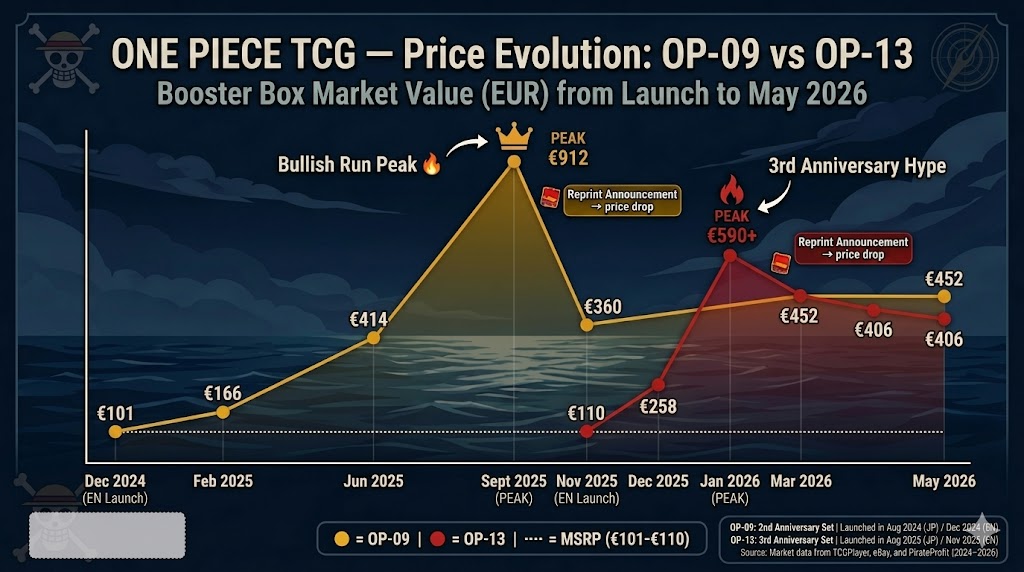
To understand the potential, we must look at the hard numbers. Anniversary sets and those featuring "The Four Emperors" have historically outperformed standard sets.
"The true value of a One Piece set isn't just in its rarity, but in how many iconic 'Manga' moments it captures. Narrative value often dictates long-term market floors."
Standout individual cards
The "Manga Rares" remain the flagship of One Piece TCG investing. From the early success of Sogeking and Ace to the 2026 staples found in OP-09 Emperors in the New World, these cards have a supply-demand imbalance that favours the seller. However, it is vital to note cases where prices did NOT go up: sets with weak competitive utility or over-printed promos often see a 15-30% retracement after the initial release month.
Risks most articles skip: The "Hidden" dangers
If you are looking to invest in One Piece TCG, you must be aware of the pitfalls:
- Bandai Reprints: Unlike "The Reserved List" in Magic, Bandai has no qualms about reprinting popular sets if demand justifies it. This can instantly slash the value of sealed boxes.
- European Liquidity: Selling a £2,000 Manga Rare is not instantaneous. Market fees (8-15%) and the time to find a verified buyer must be factored into your ROI.
- Counterfeits: As values rise, so does the quality of "proxies". High-end investing requires a loupe and knowledge of Bandai's specific holo-patterns.
- Storage: The European climate (humidity in the UK or high heat in Spain) can warp cards. Professional storage or humidity-controlled cases are non-negotiable for high-tier assets.
Sensible strategies for 2026
Instead of "going all in," consider a diversified approach. A common strategy used by collectors in our verified store directory involves a 60/30/10 split:
- 60% Sealed Anniversary Sets: Boxes like OP-01, OP-05, and OP-09 have shown historical resilience.
- 30% Competitive/Collectable Singles: Alt-art leaders that define the meta.
- 10% High-Risk Promos: Event-exclusive cards (Regional/Finals promos) which have the lowest supply.
Pro Tip: Leverage the "Post-Launch Dip". Historically, prices tend to bottom out 2 to 6 weeks after a set release as the initial "hype" supply floods the market and competitive players finish building their decks.
Verdict: Should you invest?
Investing in One Piece TCG makes sense if you have a 2+ year horizon and an interest in the franchise. It does not make sense if you are looking for a "get rich quick" scheme or if you cannot afford for the capital to be illiquid for months at a time.
Frequently Asked Questions (FAQ)
Is investing in One Piece TCG legal in the UK / EU?
Yes. Cards are considered collectable goods. However, if you trade habitually with the intent to make a profit, you may be subject to Capital Gains Tax or professional trading regulations. Always consult a tax professional in your specific jurisdiction.
How much money do I need to start?
While you can start with a single booster box (£80-£120), a diversified position usually requires between £500 and £1,000 to cover various sets and risk levels.
Is it worth grading One Piece TCG cards?
Only for high-value cards (>£200) that are in "Pack Fresh" condition. Grading a standard Super Rare (SR) rarely adds enough value to cover the grading and shipping fees. Check our PSA/BGS grading guide for more details.
Disclaimer: This article is for informational purposes only and does not constitute financial advice. TCG markets are volatile; only spend what you can afford to lose.
Get preorder alerts
Be the first to know when preorders open for new One Piece TCG sets.